
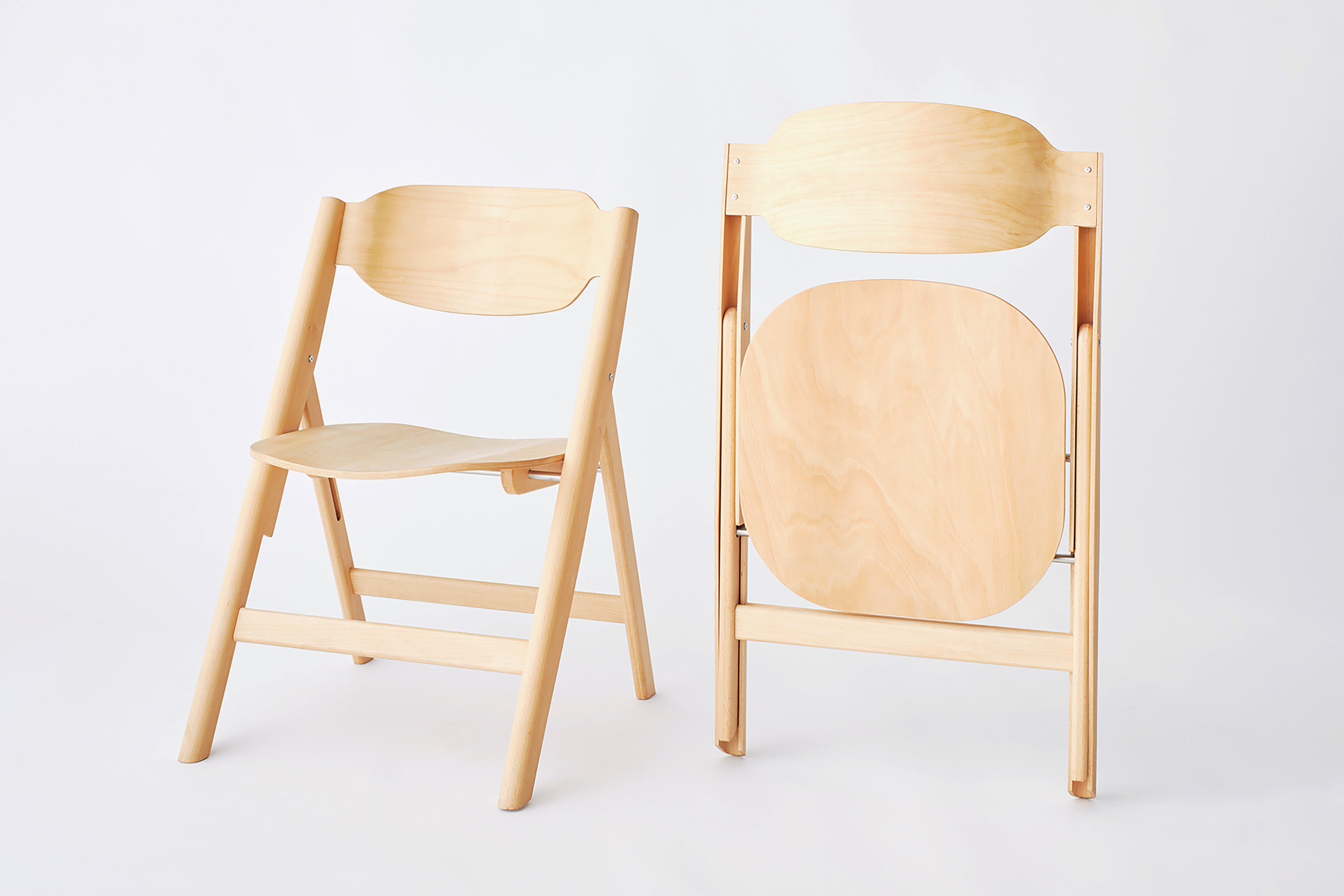
The award programme also highlights up-and-coming names in the industry, awarding the Emerging Furniture Designer of the Year title to Allyssa Kim. A student at Tokyo’s Musashino Art University, Kim caught the attention of the jury with Pitta, a folding chair that moves past the usual limitations of portable furniture.
While most temporary seating options sacrifice style for utility, Pitta retains a strong visual identity whether it is set up or folded away. The key lies in its U-shaped laminated wood leg, which tucks flat into the main frame to form a clean, sturdy, and memorable silhouette. In this piece, the utility and the appearance are entirely dependent on one another.
Could you tell us a little about your journey into furniture design? What first drew you to designing objects that become part of people’s everyday lives?
I have always enjoyed taking walks since I was a child. In particular, I loved walking through residential neighborhoods and imagining the spaces and lives behind the windows of people’s homes. Looking back, I think my interest in how people live, the spaces they inhabit, and the objects that surround them became the starting point of my journey into design.
I studied architecture and interior design at university, and after graduating, I worked in interior construction management. While being involved in the process of transforming designs into actual spaces, I gradually started making my own furniture and products for my everyday life.
Through making these objects, I began to ask myself questions such as, “How do I want to live?” and “What do I really need in my life?” This experience made me realize that furniture is not simply something with a certain form or function, but rather a “tool” that reflects the user’s lifestyle and values. That perspective became one of the things I find most fascinating about furniture design.
Wanting to explore this idea more deeply, I decided to pursue graduate studies. While searching for a program, I came across an interview with Professor Wataru Kumano, where he talked about the idea that “in order to create forms, designers must first think about the people who use them.” I strongly connected with his approach of viewing furniture and products as tools for everyday life, with an emphasis on practicality and function. Since this perspective closely aligned with my own experiences and ideas, I decided to continue my studies in my current graduate program under this philosophy.

Allyssa Kim
When you began developing Pitta, what was the initial problem or question you wanted to solve? What inspired you to rethink the traditional folding chair?
When I began developing Pitta, a folding chair, I was inspired by the Japanese tradition of using furniture and tools that allow limited spaces to be used flexibly.
In Japan, objects such as futons, which can be folded and stored away when not in use, and folding screens have long been designed to adapt to different situations in daily life. They allow people to transform the way they use their living spaces depending on their needs. I believe these objects represent a unique relationship between furniture and the characteristics of Japanese homes.
Although Western-style furniture, such as chairs and tables, has become an established part of Japanese lifestyles over many years, I felt there was still room to explore furniture that better responds to the way people live in contemporary Japanese spaces. This became the starting point for rethinking the traditional folding chair.
Many conventional folding chairs feel as though their folded form is only a temporary state, and when used as chairs, they often lack the sense of stability and comfort found in regular chairs.
With Pitta, I wanted to create a folding chair that has value in both states: a beautiful presence when folded and stored, and a sense of stability and comfort when used as a chair, while naturally blending into the surrounding space.
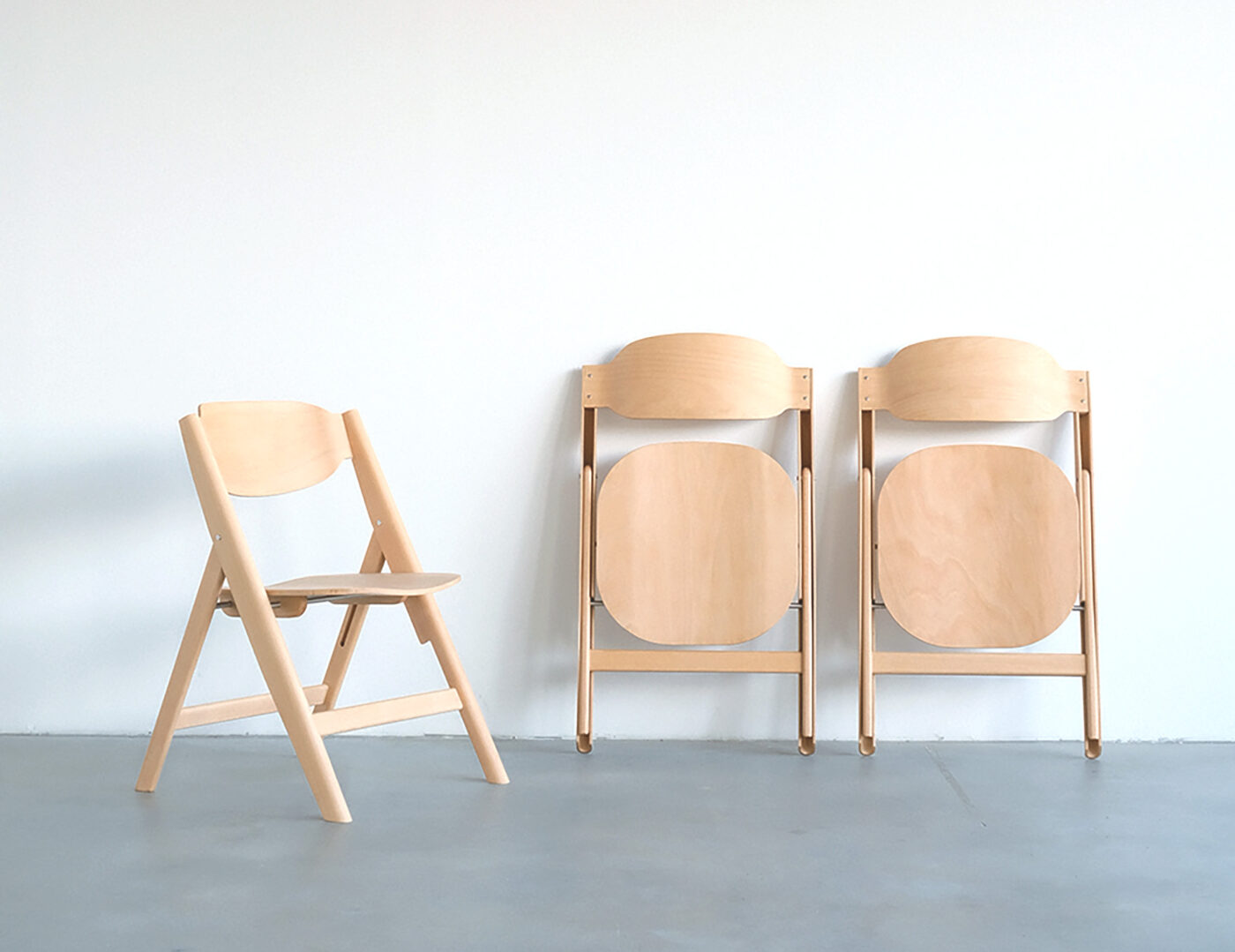
Pitta by Allyssa Kim
Pitta is designed to feel equally beautiful whether it is open or folded. How did this idea influence your design process, and what were the biggest challenges in achieving that balance?
When designing Pitta, I wanted to consider the folded state not simply as a moment of storage, but as another completed form of the chair. I also wanted to create an experience where users would feel encouraged to fold the chair, rather than seeing it as a troublesome task.
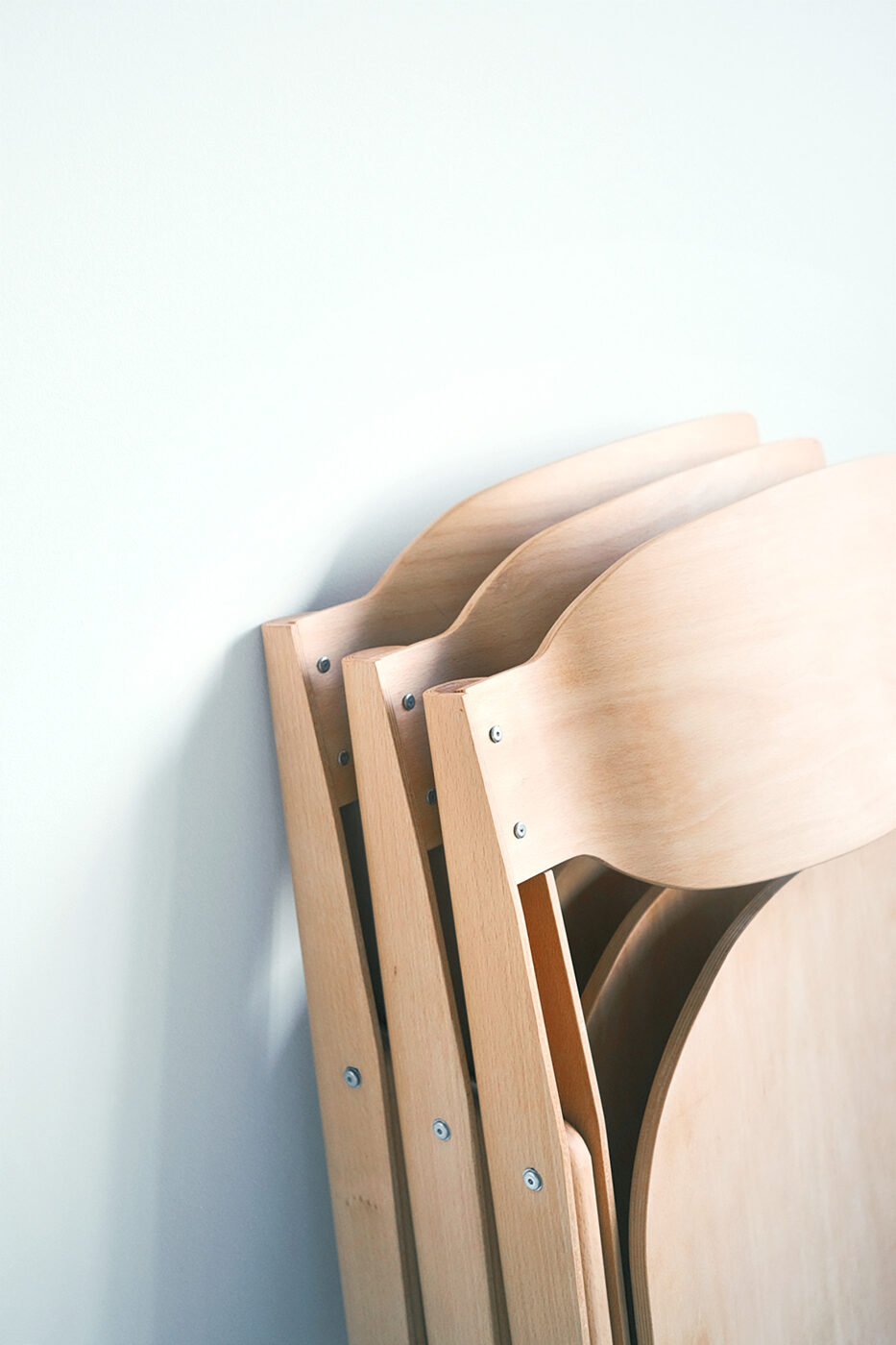
Therefore, I focused on creating a structure that would be beautiful and meaningful in both its open and folded states. Through this process, I developed the idea of using U-shaped molded plywood front legs, with the rear legs fitting neatly into the space created by the U-shaped legs when folded. This structure allowed the chair to have a unified and elegant appearance when folded, while maintaining the stability and comfort expected from a regular chair when in use.
The biggest challenge was not only shaping the U-shaped legs, but also refining the details and connections around this distinctive structure while maintaining its beauty and functionality. I worked through these challenges by repeatedly creating and testing mock-ups, gradually refining the balance between structure, function, and appearance.
The chair’s distinctive U-shaped laminated wood frame is both a structural and aesthetic feature. Could you tell us more about how this solution evolved and what it allowed you to achieve in terms of functionality, durability and visual identity?
While exploring how to create a folding chair that could remain compact while also maintaining a beautiful appearance when folded, a major challenge was how to resolve the visual presence of the legs when the chair was stored. I began to consider whether the legs could be designed not merely as structural elements, but as a form that appears as a single leg when folded.
A major influence in developing this idea was Kaare Klint’s Propeller Stool. I was deeply inspired by the beauty created by the way its carved curved parts come together to appear as a single leg when folded. Seeing this work became an important motivation for me to further explore this approach.
At the same time, I believed that prioritizing a compact appearance at the expense of structural integrity would undermine the purpose of a folding chair. Therefore, I aimed to achieve a balance between functionality and aesthetics, which led me to develop the U-shaped molded plywood legs. Through their cross-sectional form, these legs achieve sufficient rigidity even with thin material, creating a structure that is both lightweight and durable.
Furthermore, this unique structure itself has become a defining visual feature of Pitta, allowing it to have its own identity as a folding chair while maintaining beauty even in its folded state.
One of the most interesting aspects of Pitta is that its structure becomes the design itself. Was there a particular moment during the project when you realised you had found the right solution?
The moment when I became confident that this structure was the right solution was when I discovered the potential of forming the U-shaped legs.
In the early stages of development, some of my professors suggested that creating such a sharp U-shaped curve with molded plywood might be extremely difficult. However, I did not want to give up without testing the possibility myself, so I decided to create a prototype.
Although the prototype was not yet a finished product, it confirmed that the plywood could be successfully formed into the U-shape while still maintaining sufficient strength.
Furthermore, by experiencing how the rear legs naturally fit into the space created by the U-shaped legs, and by feeling the smooth and satisfying movement of folding the chair through the prototype, I realized that this structure was not only a functional solution, but also a design that adds value and enjoyment to the act of folding the chair itself.
Congratulations on receiving the Emerging Furniture Designer of the Year award! What does this recognition mean to you at this stage of your career, and how has it influenced your confidence as a designer?
I had opportunities to present Pitta in Japan, but I had never shared my work internationally, so applying for this award was a challenge where I did not know how my design would be received. However, I wanted to discover how my work would be evaluated beyond Japan and across different cultures, which motivated me to apply for this award.
Through this recognition, and by having many people see and appreciate Pitta, I felt a stronger connection between my design and society. This experience has given me greater confidence in my ideas and my approach as a designer.
Furthermore, this award has led to discussions with JIFANG, a furniture brand, about the commercialization of Pitta. I look forward to the day when this chair becomes part of someone’s everyday life and is used naturally in their home.
As a recent graduate from Musashino Art University, how has your education shaped your approach to furniture design, and what lessons from your time there continue to influence your work?
Through my studies at Musashino Art University, I have learned that an important part of my approach to furniture design is finding a balance between a calm and steady process of refinement and the passion to continue pursuing the initial impulse that sparks an idea.
During the design process, I learned the importance of repeated testing and of patiently engaging with each challenge. Rather than making decisions only in my mind or through digital data, I create physical models and evaluate them through direct interaction, which allows me to deepen my understanding of the design. Through carefully examining details and continuously refining through trial and error, I have experienced how a design can develop into something stronger and more complete.
At the same time, I value the initial impulse that becomes the starting point of a design. Although the first idea may still be rough, I believe it often contains the essential qualities of the design. Discovering those qualities, analyzing them, and refining them into a more sophisticated form is another important lesson I gained through my time at university.
Going forward, I hope to continue designing furniture by valuing both the initial impulse that drives an idea and the calm, patient process of testing and refinement that brings it to completion.
Looking ahead, what kinds of projects or ideas are you most excited to explore next? Do you see yourself continuing to develop furniture that reimagines everyday objects, or are there new directions you’d like to pursue?
Going forward, I would like to continue designing furniture and products based on the theme of “furniture as tools,” which has remained a consistent focus throughout my work.
Until now, I have created furniture based on my own ideas and experiences in daily life, shaping them from my own perspective. However, through the commercialization of Pitta, my design is entering a new stage where it will become part of someone’s everyday life.
By allowing my work, which previously existed within my own creative process, to reach actual users, I hope to gain a deeper understanding of the role that furniture and products can play in people’s lives.
For me, furniture and products are not simply objects that make life more convenient; they are things that engage with people’s lifestyles and become connected to their daily actions and senses. Moving forward, I would like to further explore the relationship between people and objects, and challenge myself to create more interactive products that encourage meaningful connections with their users.
I hope to design furniture and products that people naturally want to engage with, and through everyday use, discover new values and experiences.